
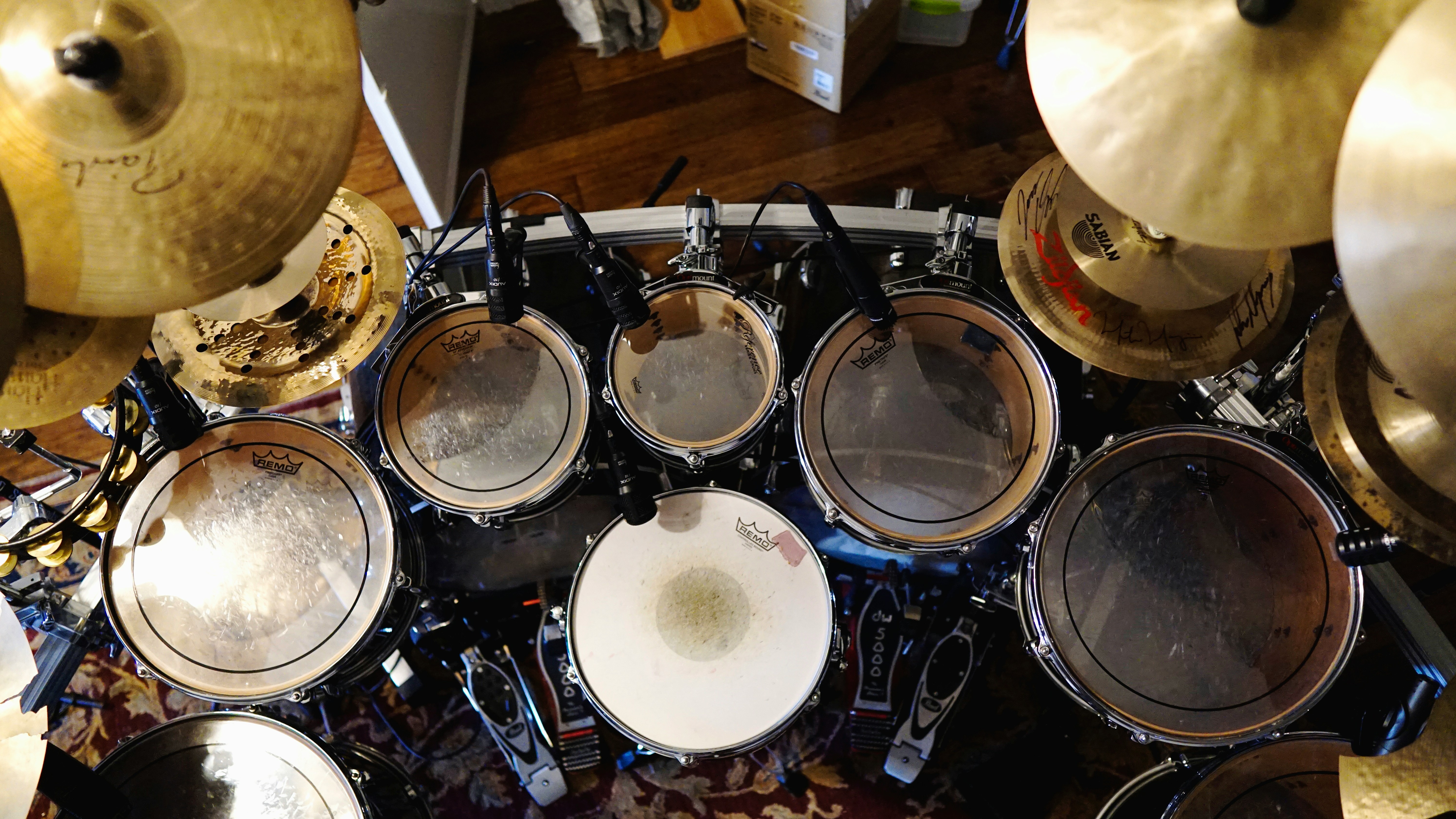
Fix the source first, because no placement rescues a bad-sounding kit. Tune the drums. Put a blanket or pillow inside the kick. Dampen any head that rings. Keep the kit out of the corner, since corners pile up boom around the kick and floor tom. If the room is small and untreated, like most rehearsal rooms, accept that it will be audible and go easier on the big crashes.
You need one interface input per mic, nothing more. A 4-input interface covers everything in this post: the Behringer UMC404HD has four preamps with phantom power, sells for around $100 to $139, and is the default answer in budget threads for exactly this job.
One mic: the mono kit
Put a single mic at the drummer's head height, just above and behind them, angled so it sees the whole kit. Or stand it out front on a boom, about five feet up, facing the drums. Balance by moving the mic, not the faders. Too much cymbal? Bring the mic closer to the drums and away from the cymbals. Not enough kick? Angle it down toward the shells.
One mic buys you simplicity: zero phase issues, because there is nothing to be out of phase with. The cost is control. Kick, snare and cymbals are frozen into one mono picture, and if the balance was wrong on the day, it stays wrong. For a songwriting reference or a rough demo, that trade is fine. Just know you are making it.
Recording drums with two mics: kick plus overhead
This is the rehearsal room workhorse. One mic goes on the kick, in or just outside the port hole. One condenser goes centered over the kit, starting about a foot above the highest cymbal, a little lower if the room reflections are ugly. The overhead captures the whole kit in its natural balance, and the kick mic adds back the one thing overheads always miss, the low-end punch.
Two well-placed mics often sound punchier than a sloppy eight-mic setup, because fewer mics means fewer phase relationships that can smear the attack. For the kick, the Shure PGA52 runs about $140, and the Beta 52A at roughly $200 adds big subby lows; either will outlive your band. For the overhead, any small condenser with a pad switch works; one of the pair picks in the four-mic section is plenty.
Three mics: the Glyn Johns method
Glyn Johns rarely put more than three or four mics on a kit. That was enough for John Bonham, and for Keith Moon on Who's Next. Johns kept mics three to four feet out; in his words, that is where the sound of each drum actually comes into fruition. The method works because it treats the kit as one instrument instead of twelve.
The placement: first mic 40 to 60 inches directly above the snare, pointing straight down. Second mic just to the right of the floor tom, about six inches above the rim, aimed across the kit toward the hi-hat and snare. Kick mic in or near the port. The rule that makes or breaks it: both mics must be exactly the same distance from the center of the snare, measured with a mic cable or a piece of string, never eyeballed. Get it wrong and the snare turns thin, because it arrives at the two mics slightly out of time and partially cancels.
One caveat: the cymbals come out loud. That is built into the technique, not a mistake you made. Set the overheads for a good cymbal level, bring the kick up underneath, and have your drummer hit the cymbals lighter. Drummers who record well with three mics play quiet cymbals on purpose.
Four mics: kick, snare and two overheads
Add a Shure SM57 on the snare, two to three inches above the rim, angled at the center of the head. It has barely changed since 1965, costs about $99, and its presence bump around 3 to 6 kHz is the snare crack on thousands of records.
For the overhead pair, use the Recorderman placement. First mic two drumstick lengths, roughly 40 inches, directly above the snare pointing down. Second mic over the drummer's right shoulder, aimed at the snare. Now the measuring ritual that keeps the pair in phase: hold a mic cable from the kick beater's contact point to the first mic, pinch it, then check that length reaches the second mic. Repeat from the snare center. Both mics equidistant from both drums, which stops the kick and snare from hollowing out when the signals combine.
Budget overheads are solved. A Behringer C-2 matched pair costs about $52 to $60 and works; reviewers consistently call the $180 Samson C02 pair worth the stretch.
Gain staging so the cymbals never clip
Cymbals produce the fastest, hottest peaks on the kit, and they clip first. Set your gain while the drummer plays the loudest chorus of the night, not a polite warm-up groove. Aim for peaks around -6 to -12 dBFS, with cymbal-heavy channels like overheads peaking closer to -15 to -12 dBFS and the average level near -18 dBFS. That looks timid on the meters. It is correct. Engage the pad switch on overheads and snare if the preamp still runs hot.
Be strict here, because digital clipping is permanent. Anything that slams into 0 dBFS gets clipped, and that distortion is something no plugin, engineer, or AI can reconstruct. Clipping sits at the top of The 5 Most Common Mistakes in Home Recordings for a reason.
One mic, one track: the part that pays off later
Whatever recipe you picked, record each mic to its own track. Do not bounce the kit to a single stereo file to keep things tidy. When the session ends, export each drum track as its own stem: all the same length, all starting at bar one even if the drums wait eight bars, WAV or FLAC, no limiter on anything. If you are capturing the whole band that night, How to Record a Band Rehearsal That's Actually Mixable covers the other instruments.
This matters more than which mic you bought. Even two drum stems transform a mix. With kick and overhead separate, whoever mixes the song, human or machine, can push the kick up against the bass and pull the cymbal wash down under the vocal. With four-, the snare can come forward in the chorus and the overheads open into a real stereo picture. How to Mix a Full Band From Stems shows that balancing act in detail.
Bandmixr is built for exactly this input. It checks every file for level, tone, phase, and clipping first, resolves clashes between the kick and the bass, and gives you per-stem faders afterward so you can nudge the snare yourself.
Next rehearsal, set up one of these recipes, watch the meters, and take the stems home. Upload them at bandmixr.com and hear what your kit sounds like when something finally balances it properly.