
The digital piano: two cables, no bleed
Three settings matter on the keyboard. Turn the built-in reverb off; it will be printed into the file and you cannot remove it later. Turn any built-in EQ or "brilliance" to flat. And check the velocity curve: many stage pianos ship with a curve that makes soft playing inaudible, so pick the curve where your quiet playing still registers.
Record the piano as one stereo file. Set the level so the biggest chord peaks around -12 dB.
The gift of this setup is zero bleed. The vocal mic hears only the voice, because the piano exists only as a signal in a cable. That means you can record both at once with no compromise, and the singer can stand wherever the room sounds least bad.
The upright: two mics and a decision
Before anything else: get it tuned. A piano that is a little out of tune with itself sounds fine in the living room and sounds like a saloon on a recording. Tuning costs less than a mic and improves the result more.
Then choose where the mics go, and there are two honest options.
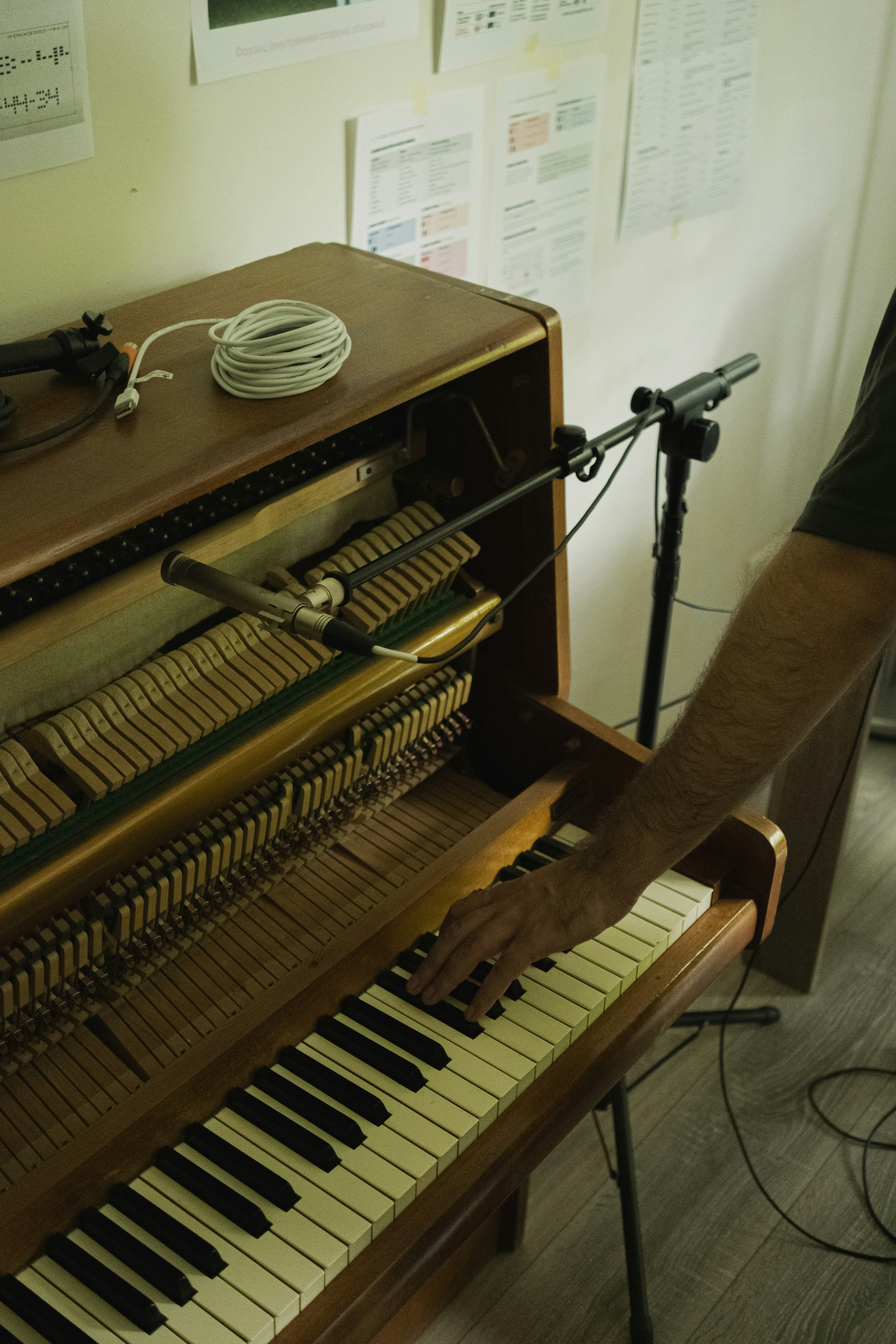
Open the top lid and put two mics above it, a spaced pair roughly 30 to 40 centimeters apart, one over the bass strings and one over the treble, 20 to 30 centimeters above the strings. This gives you a bright, present piano and a bit of the hammers, and it works well for pop and singer-songwriter material.
Or take off the lower front panel, below the keyboard, and put the two mics there, pointing at the soundboard. This gives you a warmer, fuller sound with fewer mechanical noises, and it is often the better choice for ballads and jazz. It also puts the mics further from the singer, which helps with bleed.
Either way, the two mics are one source. Keep them the same distance from the strings so they do not cancel each other, and pan-check later: if the piano sounds thinner with both mics than with one, the spacing is wrong.
Now the singer. Same rules as ever: dynamic mic, close, pop filter, and placed so the back of the vocal mic faces the piano. Standing beside the piano rather than in front of it keeps the vocal mic out of the piano's loudest direction. If the bleed is still bad, overdub the voice after the piano; an upright played alone is far easier to sing over from headphones than a guitar is.
Also listen for the pedal. A squeaky sustain pedal shows up on every mic in the room and it cannot be edited out of a sustained chord. A drop of oil before the session is worth more than any plugin.
Export and label
Digital piano: one stereo WAV, labeled Piano. Upright: two mono WAVs, both labeled Piano. Bandmixr treats two mics on the same instrument as one source rather than two competing ones, so it will not carve one mic out of the way of the other, and it checks them for polarity problems. The vocal is its own file, labeled Vocal Lead.
Everything starts at zero, nothing normalized, no reverb or compression printed in.
For genre, pick Acoustic/Folk for singer-songwriter material and Jazz for standards and ballads. Both keep the dynamics of the playing, which is the whole point of a piano recording; the jazz profile leaves even more of them alone and masters quieter, which is what that music wants. Pop is the right choice if the piano is one layer under a produced vocal rather than the whole accompaniment.
What each setup gives the mix
The direct keyboard arrives clean and wide, and the mix mostly has to make it sound less like a sample library: a touch of room, a little less top end, and a level that sits under the voice without disappearing. The upright arrives with the room, the hammers and the singer's bleed all in the files, and the mix has to tame the low-mid buildup an upright always has, keep the two mics coherent, and put the voice on top without pulling the piano bleed up with it.
Neither mix can fix a piano that was out of tune, a pedal that squeaked, or reverb that was printed at the keyboard. Those are all solved before the record button.
How to Record and Mix Guitar and Voice at Home With One Interface covers the same ground for guitarists, and How Many Stems for Mixing? explains what to do when a cello and a second voice join in.
Upload the piano and vocal files to bandmixr.com, pick your genre, and compare the first mix to your rough bounce at the same volume. The first download is free.