

You upload stems. You get a polished mix. But what actually happens in between? This post opens up the engine and explains the processing chain, step by step.
Analysis comes first
Before any processing happens, every stem gets analyzed individually. This isn't just a volume check. The system measures:
- Loudness (peak, RMS, and LUFS) to understand how loud each track actually is
- Frequency content (spectral centroid, rolloff, flatness) to understand what part of the spectrum each instrument occupies
- Dynamic range and crest factor to gauge how compressed or dynamic the recording is
- Phase correlation to catch mono compatibility problems
- Noise floor to detect background hiss or hum
- Clipping to identify and classify distortion (none, mild, or severe)
On top of signal analysis, a second pass extracts musical information: BPM, beat positions, estimated key, and whether the audio is more percussive or harmonic. This data feeds into the mixing decisions.
The decision engine
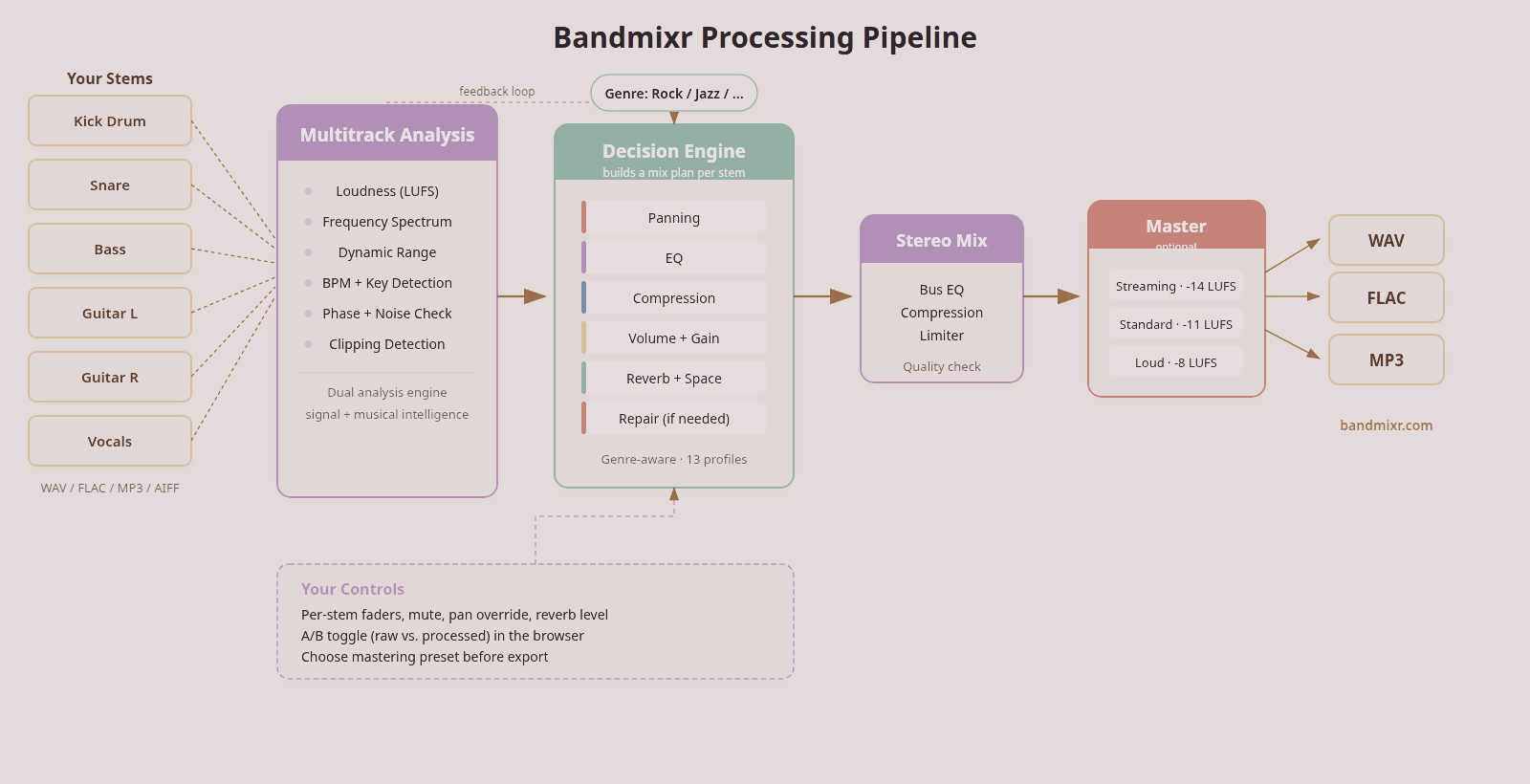
This is the core of Bandmixr. It's a multi-layer system that builds a processing plan for each stem.
Layer 1: Instrument defaults. Each instrument type (kick, snare, vocal, electric guitar, etc.) has baseline settings for EQ, compression, panning, reverb, and gain. A kick drum gets low-end emphasis and tight compression. A lead vocal gets presence boost and moderate compression. These are starting points, not final values.
Layer 2: Genre adjustments. Your genre selection shifts those defaults. A rock mix pushes guitar mids and tightens the drum bus. An acoustic mix preserves dynamics and adds more room reverb. An electronic mix emphasizes sub-bass and applies harder compression. Bandmixr currently supports 13 genre profiles.
Layer 3: Signal corrections. The analysis data from step one kicks in here. If a stem has a narrow dynamic range, compression backs off. If the spectral shape is unusual for its instrument type, EQ adapts. If there's a DC offset, it gets removed. Phase issues get flagged for correction.
Layer 4: Musical adjustments. BPM data tunes compressor attack and release times so they breathe with the song. Key detection informs EQ decisions to avoid boosting frequencies that clash with the harmonic content.
Layer 5: Context awareness. The engine looks at the full arrangement, not just individual stems. If two instruments compete in the same frequency range, one gets carved out. Sidechain compression gets applied where it makes sense (kick ducking the bass, for example). Panning spreads instruments across the stereo field based on what else is in the mix.
Layer 6: Your fine-tune settings. Any fader, mute, or pan adjustments you've made override the automatic decisions. The system respects your choices.
Processing
Once the plan is built, processing happens through a dedicated audio engine. Each stem goes through its assigned chain: repair (if needed), then EQ, compression, saturation, panning, and reverb sends. All stems get mixed to a stereo bus, which gets its own master chain (EQ, compression, limiting).
Quality check
The output gets validated automatically. The system checks for clipping, excessive loudness, phase problems, and noise. If something is off, it flags the issue.
The result
You get a mixed stereo file in WAV, FLAC, and MP3. If you chose mastering, a second pass applies loudness normalization and final EQ shaping to your chosen target (streaming, standard, or loud).